- Work Advice Made Simple
- Posts
- Doubting? Then Speak Up Before You Nod Along
Doubting? Then Speak Up Before You Nod Along
A simple acronym to help you ask sharper questions, avoid groupthink, and make smarter decisions

Scott Henderson
June 11, 2025
Photo from Tima Miroshnichenko
Maybe you’ve sat in a meeting when someone says “research shows…” and you think, “Is that true? What research?”
Or you’ve been presented a number about some business metric, it gave you pause, then they told you how they got that metric and you thought, “well that’s misleading.”
Learning to ask skeptical questions—and being brave enough to ask them—can save us from costly mistakes and embarrassing oversights.
Why we don’t always ask & why we need to
We worry about looking dumb, so we swallow our skepticism hoping things will just turn out.
Leaders or peers sometimes discourage curiosity, making us feel like we will rock the boat in a bad way if we question them.
No one is immune to being fooled. People fall for well-crafted narratives and polished presentations every day. One of the most lighthearted and fun examples of this is, The Magic Prank Show on Netflix.
By blending magic with candid-camera scenarios, it shows how easily we make our brains fill in gaps—so much so that we’ll believe crazy things. One of my favorite pranks is when a restaurant goer is tricked into believing their date was a ghost who disappears in front of them.
This is a very lighthearted example BUT there are endless amounts of more serious, illegal, and costly examples out there (i.e., Theranos, WeWork, Peoples Temple, etc.)
Three Steps to Start Thinking More Clearly
Oftentimes people share opinions or interpretations like they are 100% facts. The next time you hear a claim that sounds fishy and you want to investigate—do it!
Try a FIO-Check:
Ask: What’s the evidence? How was that evidence found or created?
If there’s solid evidence (checked by third parties, verifiable, observable, clearly communicated), then it’s more likely a FACT.
If no evidence exists or it's one-sided,
ask: Whose interpretation is shaping this? Why might they want this story or version to be true?
For example, a leader might say, “Client satisfaction is through the roof!”—but they’re basing it on one glowing email from a top client. Meanwhile, survey data from dozens of others hasn’t even been reviewed. That statement is not a fact—it’s an INTERPRETATION, possibly shaped by a desire to look good in a meeting.
If someone speaks with certainty about something that can’t be tested—only agreed or disagreed with—it’s likely an opinion.
Ask: “Whose experience is being generalized?” and “What assumptions are behind this?”
If someone says, “Our clients don’t care about our branding, just that we solve their problem,” then that’s an OPINION. Instead of agreeing or disagree, ask questions —“Why do you think that? Whose feedback are you trusting? Is that true for ALL of our current and future clients?”
This is a FIO-Check! Fact, Interpretation, Opinion.
We all could FIO-Check information better before we talk about it, share it, and make decisions based on it. When we do so, we think more clearly and improve our decision making.
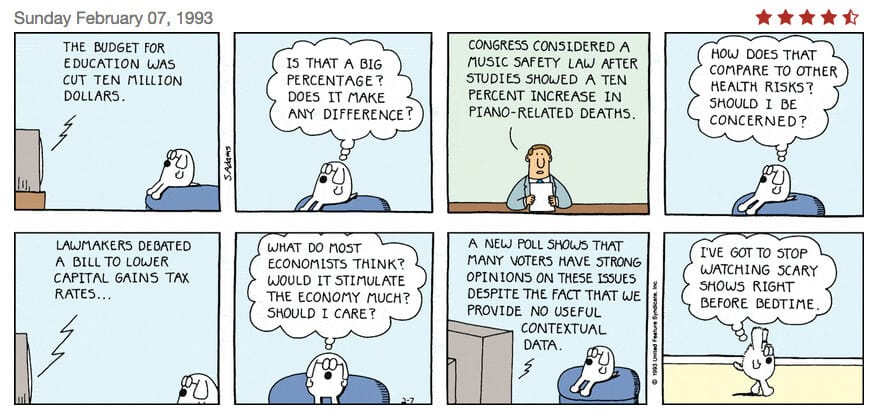
An easy way to build some awareness
This misinformation susceptibility test from the University of Cambridge is part of a larger research project. There are only 16 (or 20) questions so its quick.
It’s not 100% generalizable to your next work meeting; however, it still provides you with some awareness of how well you are at thinking clearly about claims people make.
Take the test! And in your opinion, what nudges people to believe a headline or not?
Thank you for subscribing and reading. I hope you have a great week!
Warmly,
Scott
p.s. If you’ve ever thought “Hey, this is actually useful,” then you can nows support me by contributing whatever feels right. A HUGE thanks if you do.