- Work Advice Made Simple
- Posts
- Want to Accomplish Something? Then Set Your Goals Like This
Want to Accomplish Something? Then Set Your Goals Like This
A proven method for setting goals and making progress

Scott Henderson
July 16, 2025
Photo by Tima Miroshnichenko
You ever sit down to get serious about your goals only to find that you actually don’t know what you want?
Maybe you write some things down and then pause to think “Nah, that’s not possible” or “Hmmm… do I actually want to sign up for all the work that would require?”
In my twenties I wanted to dunk a basketball. I set a goal to do it and was really excited about it; then proceeded to do nothing about it other than wish it into existence (spoiler alert - this doesn’t work).
Goal setting is easier said than done. If you’ve ever felt that gap between what you say you want and what you actually do, rest assured, studies show you’re not alone.
The real problem you and I face is not a lack of ambition and it is not an inability to follow through. It’s a lack of precision, planning, and ownership.
Goals are too often vague hopes like “do better,” “get healthy,” and “grow the business.”
We underestimate how much a clear, specific, and personally meaningful goal can move the needle.
Everyone has their own opinion on goal setting.
Make sure you set SMART goals.
Write down your goals and the likelihood of achieving them goes up.
Break down bigger goals into smaller goals.
Track your progress.
These are great tips; however, if you’re anything like me, you might need a structured step-by-step process that brings all the best advice together.
The Goal-Setting Exercise
Some researchers were curious to see how goal setting impacted struggling college student’s GPAs. The researchers found that their goal setting program significantly improved performance. They highlight how quick, effective, and inexpensive the intervention is (Morisano, et al. 2010).
Try this adapted version below sometime this week and bookmark it for future goal-setting purposes.
1. Write your “ideal future”
Take five minutes. No editing. Where do you want to be a year from now?
Be specific about what you want it to look like.
When you’re done you’ll probably have a short list of bullet points about work, personal life, health, and other categories that are important to you.
2. Extract 5-7 goals
Review the list and transform the ones that catch your attention into specific and personally meaningful goals.
For me, a bad example would be “get more readers/subscribers.” What I’d want is something like “grow my newsletter by 1,000 subscribers.”
3. Rank and reality-check
Which of these goals matter most? Which are doable in your timeframe and which are not? Only you know this.
Something that I dropped from my list when I did the exercise was “Write a pilot for a TV show” (I’ll get to it someday 🙃 ).
4. Plan backward
Just pick one goal for now. This is in the spirit of essentialism.
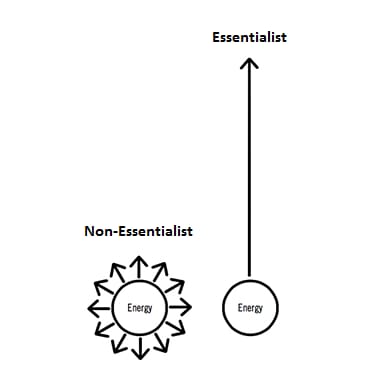
From Essentialism by Greg McKeown
Break the one goal into sub-steps to make real progress.
Be specific about what success looks like. Get clear on what you have control over, name obstacles, come up with ideas to navigate those obstacles, and lay out your next steps.
(If you haven’t already - I highly recommend looking up James Clear’s post on goals vs. systems. It’s perfect for this. His whole book, Atomic Habits, is gold for achieving goals.)
5. Commit in writing
Nothing fancy. Just get it out of your brain and on paper or saved somewhere. This could look something like:
"I commit to [specific goal] by [date]. I will do [key actions] every [day/week/month] to reach it. I will handle [big obstacle] by [solution]. I will check my progress every [frequency] and adjust as needed. This matters to me because [personal reason]."
Clearer goals reshape the way you direct your time, energy, and resources.
I would love to hear from you after you do the exercise above.
What surprised you when you wrote your goals in detail?
What small tweak could make your goals stickier for you next time?
Hit reply. Tell me what you learned — or what you’re still stuck on. Clarity beats hustle in the long-run.
Thank you for subscribing and reading. I hope you have a great week.
Warmly,
Scott
p.s. If you’ve ever thought “Hey, this is actually useful,” then you can nows support me by contributing whatever feels right. A HUGE thanks if you do.